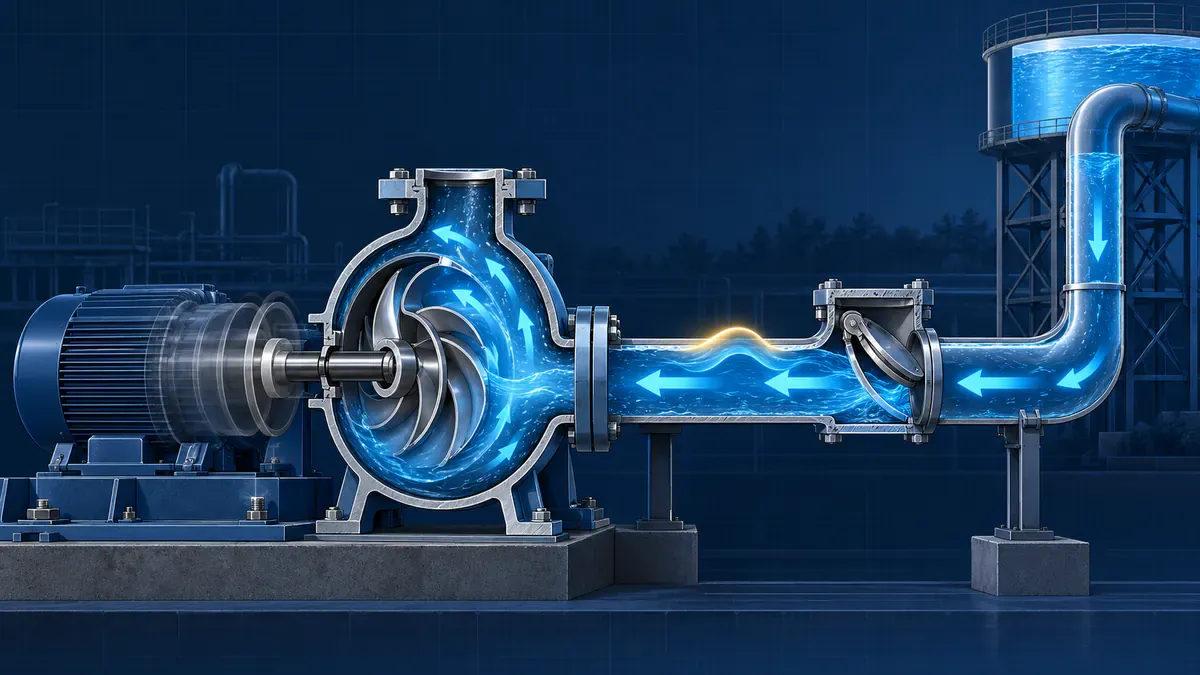
Backflow is an important possible cause of impeller damage—especially in systems with an elevated outlet, long riser, failed or slow-closing check valve, repeated pump trips or check-valve slam. It is not the only cause. Cavitation, abrasive solids, corrosion, incorrect rotation, bearing failure and operation far from the intended duty point can damage an impeller in different ways.
01 / DEFINITION
What pump backflow actually is
Backflow means liquid moves through part of the pump system in the direction opposite to normal discharge flow. It commonly begins after the motor stops while water remains above the pump or while a pressurised pipeline still contains stored hydraulic energy.
If a check valve is absent, leaking, stuck or too slow for the system, the returning water can pass through the pump. A centrifugal impeller may then rotate backwards like a turbine. The speed and torque depend on static head, pipeline profile, reverse-flow path, pump characteristics and how quickly the valve responds.
Backflow is reverse liquid movement. Reverse rotation is the resulting mechanical motion of the pump rotor. Water hammer is a pressure wave caused by a rapid velocity change. A reverse-flow event may include all three if the water accelerates backwards and is then stopped abruptly.
02 / COMMON CAUSES
Why water returns through a stopped pump
| Condition | Why reverse flow can develop | What to verify |
|---|---|---|
| Elevated tank or discharge point | Static head pushes the water column back toward the pump after shutdown. | Maximum and minimum levels, elevation profile and outlet condition. |
| Missing, leaking or stuck check valve | The discharge line has an open reverse path through the pump. | Valve installation, seat condition, debris, leakage and maintenance history. |
| Check valve closes too slowly | Reverse velocity builds before the disc reaches the seat. | Valve type, stroke, location, closing dynamics and system deceleration rate. |
| Sudden power failure or pump trip | Pump head collapses while pipeline momentum and static head remain. | Coast-down time, motor inertia, control sequence and power-failure case. |
| Several pumps connected in parallel | An operating pump may drive flow backwards through a stopped unit. | Individual check valves, manifold pressure and pump sequencing. |
| Incorrect valve or bypass arrangement | A cross-connection can provide an unintended reverse-flow route. | Actual valve positions, bypass lines, control logic and commissioning records. |
03 / IMPELLER DAMAGE
How reverse flow loads the impeller and shaft
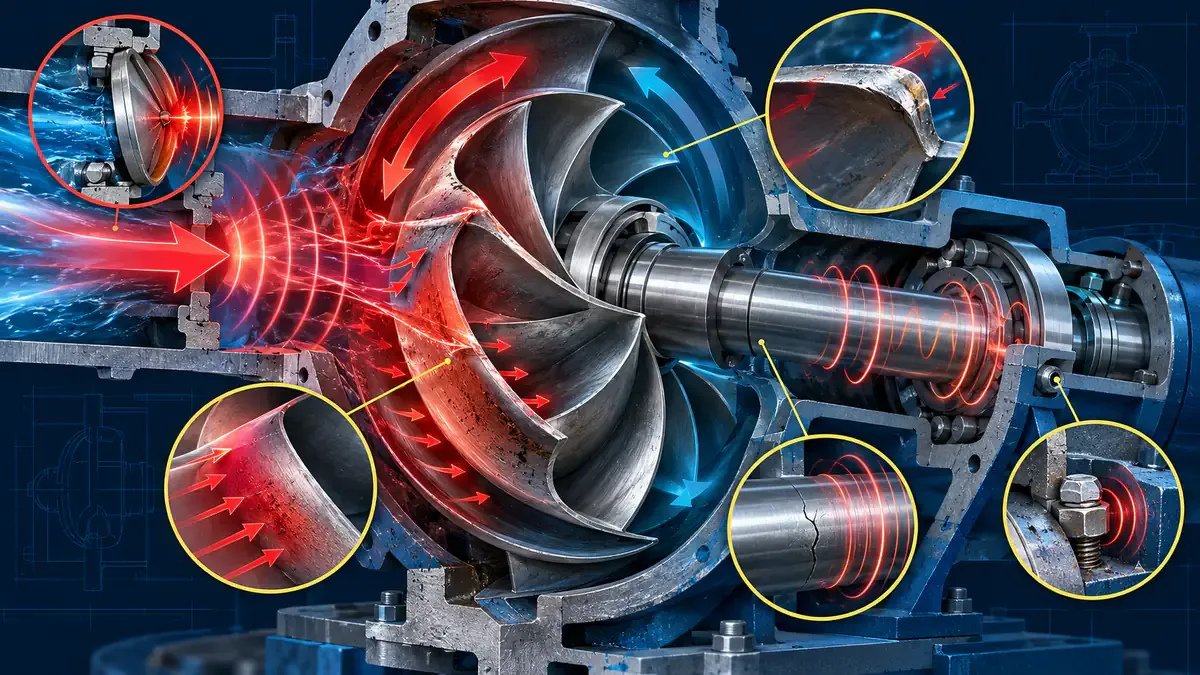
A pump is selected to operate within a defined direction and hydraulic range. Reverse flow moves across the impeller blades from the opposite direction and can drive the rotor backwards. That produces forces that are different from normal powered operation.
- Reverse hydraulic torque: returning water can accelerate the impeller in reverse and load the shaft, coupling and motor in an unintended direction.
- Check-valve slam: if reverse velocity develops and is stopped suddenly, the pressure pulse can shock the impeller, casing, shaft, seals and pipe supports.
- Repeated fatigue: frequent start-stop cycles can repeatedly change torque direction, increasing fatigue risk at blades, keys, threaded fasteners and shaft transitions.
- Overspeed in reverse: under sufficient static head, an uncontrolled pump may rotate backwards faster than expected. The permitted reverse speed must come from the manufacturer.
- Loosening or displacement: some impeller-retention arrangements can loosen when rotation and torque reverse, depending on their design and locking method.
- Bearing and seal loading: reverse rotation, thrust reversal and vibration can damage supporting components before a blade visibly fails.
A cracked, loose or damaged impeller should trigger a system review, but similar damage may also involve cavitation, debris impact, corrosion, incorrect assembly, bearing failure or an unsuitable operating point. Compare the failure with shutdown timing, check-valve condition, reverse rotation and fast pressure data.
04 / WARNING SIGNS
What an operator may notice after shutdown
Reverse spinning sound
The shaft or motor fan continues in the opposite direction after the pump stops.
Valve slam or pipe shock
A bang, check-valve impact or pipe movement occurs a short time after power is removed.
Long restart or current spike
The motor restarts while the rotor is still turning backwards, creating abnormal acceleration and electrical load.
Recurring vibration or looseness
Vibration, seal leakage, shaft movement or repeated impeller loosening appears after stop-start events.
A normal pressure gauge may not capture a short reverse-flow or slam event. Useful evidence includes shaft direction after shutdown, check-valve motion, fast suction and discharge pressure traces, motor speed decay, vibration and the exact event timeline.
05 / DIAGNOSIS
A practical sequence before replacing the impeller
- 01
Record what happens when the pump stops
Identify whether the event follows a normal stop, power failure, emergency trip or another pump starting. Note any delay before noise or reverse rotation begins.
- 02
Confirm the reverse-flow path
Trace tank levels, elevated pipe sections, parallel pumps, bypasses and all valves that could drive water back through the stopped unit.
- 03
Inspect the check valve dynamically
Do not check only whether the valve can close by hand. Verify seat leakage, debris, disc travel, closure speed, location and suitability for the actual deceleration rate.
- 04
Inspect the complete rotating assembly
Check the impeller, locking method, key, shaft, coupling, bearings, mechanical seal and motor for evidence of reverse torque or axial-load reversal.
- 05
Separate backflow from other damage mechanisms
Review cavitation, solids impact, corrosion, dry running, incorrect rotation and operation outside the intended pump curve.
- 06
Measure or model severe events
For long rising mains, high static head or repeated failures, use fast pressure logging and qualified transient analysis before selecting a remedy.
06 / PREVENTION
How to reduce damaging reverse flow
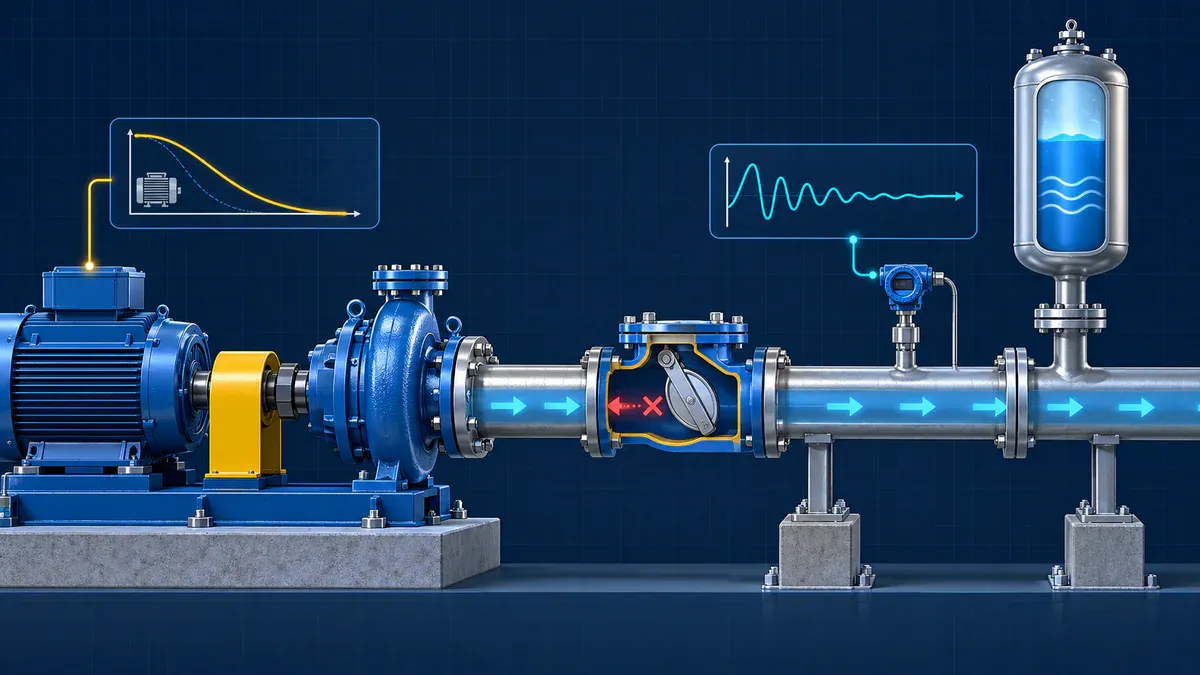
- Select the check valve for the dynamics: valve size alone is not enough; closing response must limit reverse velocity without creating excessive pressure shock.
- Locate the valve deliberately: place it according to the pump and pipeline design, accessibility, maintenance needs and transient analysis.
- Control pump deceleration where appropriate: a VFD or controlled shutdown may reduce some events, but sudden power loss must still be assessed.
- Prevent reverse restart: control logic should avoid energising a pump while its rotor is still spinning backwards unless the equipment is specifically designed for it.
- Maintain valves and strainers: debris, corrosion, worn seats and damaged hinges can turn a suitable installation into an unreliable one.
- Review parallel-pump isolation: each stopped pump may need reliable protection from manifold pressure generated by operating units.
- Use engineered surge control when necessary: long or high-head mains may require a surge vessel, relief device, revised valve timing or another analysed combination.
- Verify the result: after changes, confirm reverse speed, maximum and minimum pressure, valve response, vibration and restart behaviour.
Closing before significant reverse velocity develops can help, but an unsuitable rapid closure may produce a severe pressure transient. Valve dynamics and surge protection must be evaluated together.
07 / SUBMERSIBLE PUMPS
Why vertical risers and long discharge mains increase the concern
A borehole or submersible pump often supports a tall water column. When power is lost, gravity can drive that column backwards. A failed or delayed check valve may allow reverse rotation, while a sudden valve closure can add a damaging pressure transient.
When selecting a borehole pump, QD multistage submersible pump or QDX submersible pump, provide the vertical lift, complete discharge profile, pipe diameter and length, check-valve type and location, start-stop frequency, control method and expected power-failure sequence.
08 / QUESTIONS
Common pump backflow questions
Can reverse flow damage a pump impeller?
Yes. Significant or repeated reverse flow can apply reverse torque, abnormal blade loading and transient shock. The risk depends on reverse velocity, duration, pump design, retention method, check-valve response and the full system.
Is backflow the same as water hammer?
No. Backflow is reverse liquid movement. Water hammer is a pressure transient caused by a rapid velocity change. A check valve that stops developed reverse flow abruptly may create both backflow-related loading and water hammer.
Does any check valve solve the problem?
No. Valve type, size, location, closing dynamics and maintenance condition must suit the real pipeline. A valve that closes too late may slam, while an unsuitable fast closure can also produce a pressure spike.
Does reverse rotation always mean the impeller is damaged?
No. Some equipment can tolerate limited reverse rotation, while other designs have strict limits. Obtain the permitted direction, reverse speed and duration from the pump and motor manufacturer, then compare them with measured system behaviour.