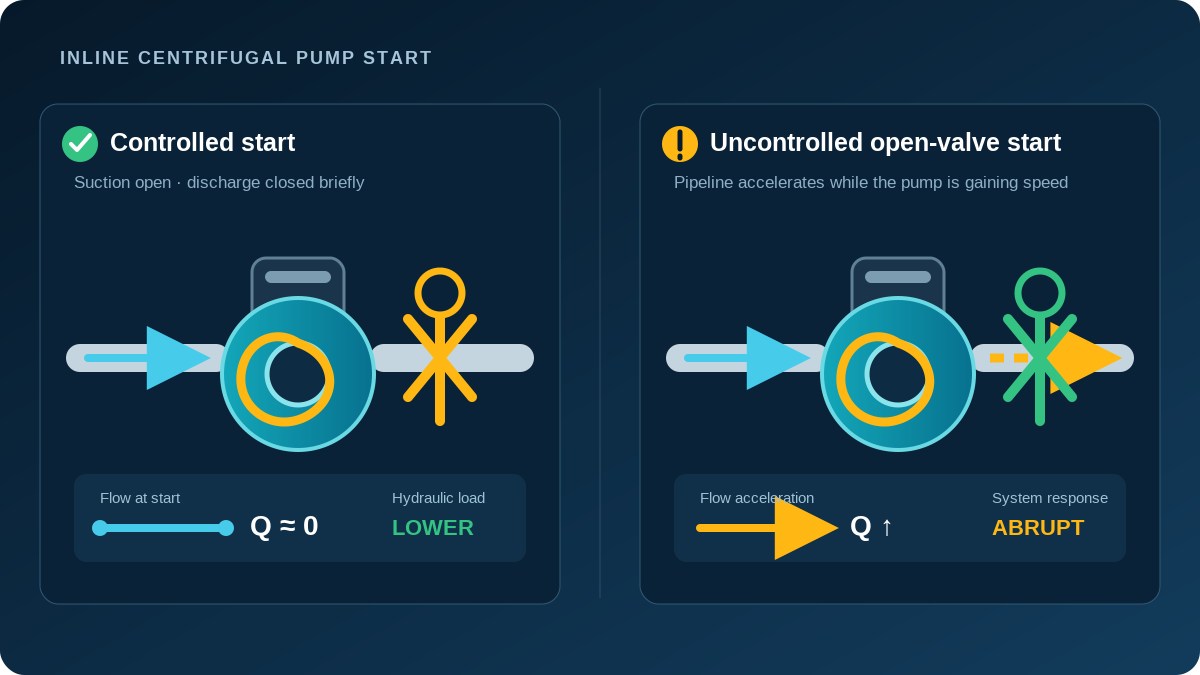
For a typical radial-flow centrifugal inline pump, absorbed power is usually lower near shutoff than at normal or high flow. Closing the discharge valve briefly therefore reduces the hydraulic torque that develops as the pump reaches speed. It also prevents the full pipeline flow from appearing suddenly. Once rotation, pressure and sound are normal, open the discharge valve gradually to the duty point. Never close the suction valve for starting, and never leave the pump running at shutoff for long.
01 / OPERATING PRINCIPLE
What changes when the outlet valve is closed
An inline pump is still a centrifugal pump: the impeller adds energy to the liquid, and the volute or diffuser converts part of the liquid velocity into pressure. With the discharge valve closed, the pump produces its shutoff head but the external flow is approximately zero.
The hydraulic output delivered to the system follows the relationship Ph = ρgQH. At shutoff, flow Q is nearly zero, so useful hydraulic output is also nearly zero even though the casing is pressurised. The motor still supplies power for disc friction, internal leakage, bearing and seal friction, liquid recirculation and electrical losses, so input power is not zero.
The pump must be primed and free of trapped air before starting. Throttling or closing the suction valve lowers inlet pressure and can cause dry running, unstable flow or cavitation. Flow control belongs on the discharge side unless the manufacturer specifies another arrangement.
02 / POWER AND CURRENT
Why the pump accelerates under a lighter hydraulic load
For many radial-flow centrifugal pumps, the absorbed-power curve rises as flow increases. Starting near zero flow therefore keeps hydraulic torque lower while the pump rotor and motor accelerate. After rated speed is reached, gradual opening moves the operating point along the pump and system curves toward the required flow.
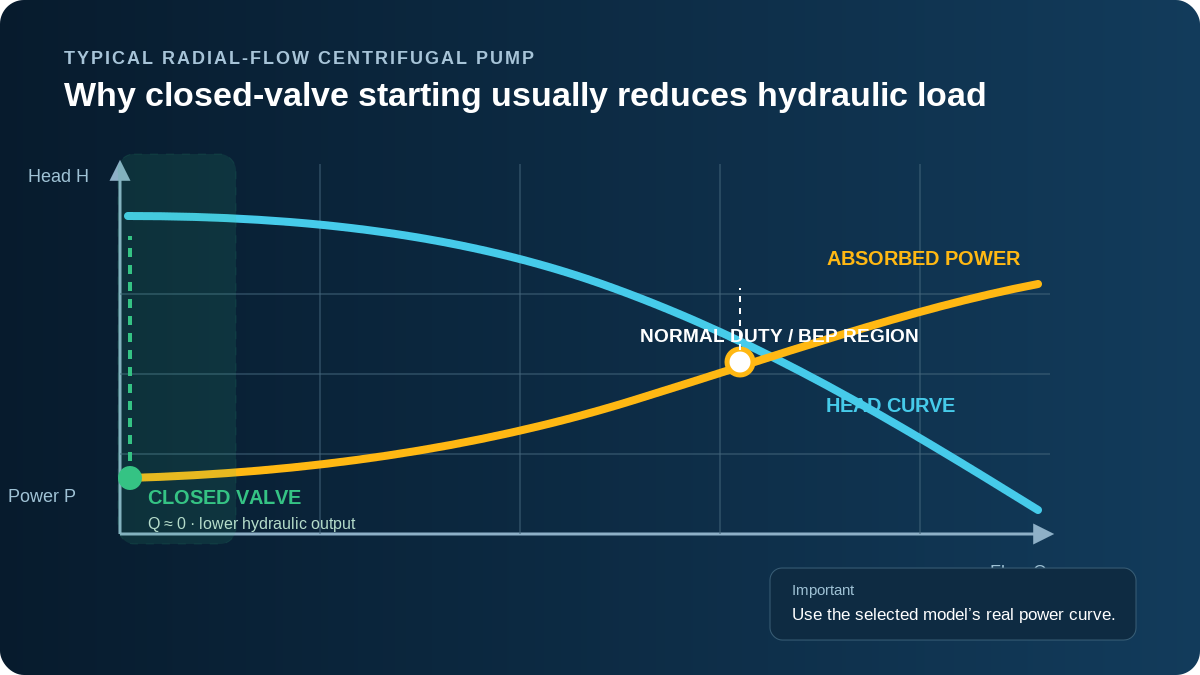
A direct-on-line induction motor can still draw several times rated current at the instant of energisation. Valve position mainly changes the hydraulic torque that builds as speed and flow develop. Cable, starter, protection and transformer capacity must still be selected for the motor’s real starting method and data.
A soft starter or variable-frequency drive can reduce acceleration shock and may limit current, but it does not automatically replace the correct valve sequence. The control logic must still avoid dry running, prolonged low-flow operation and an abrupt transition to full flow.
03 / STARTUP SEQUENCE
A practical four-step procedure
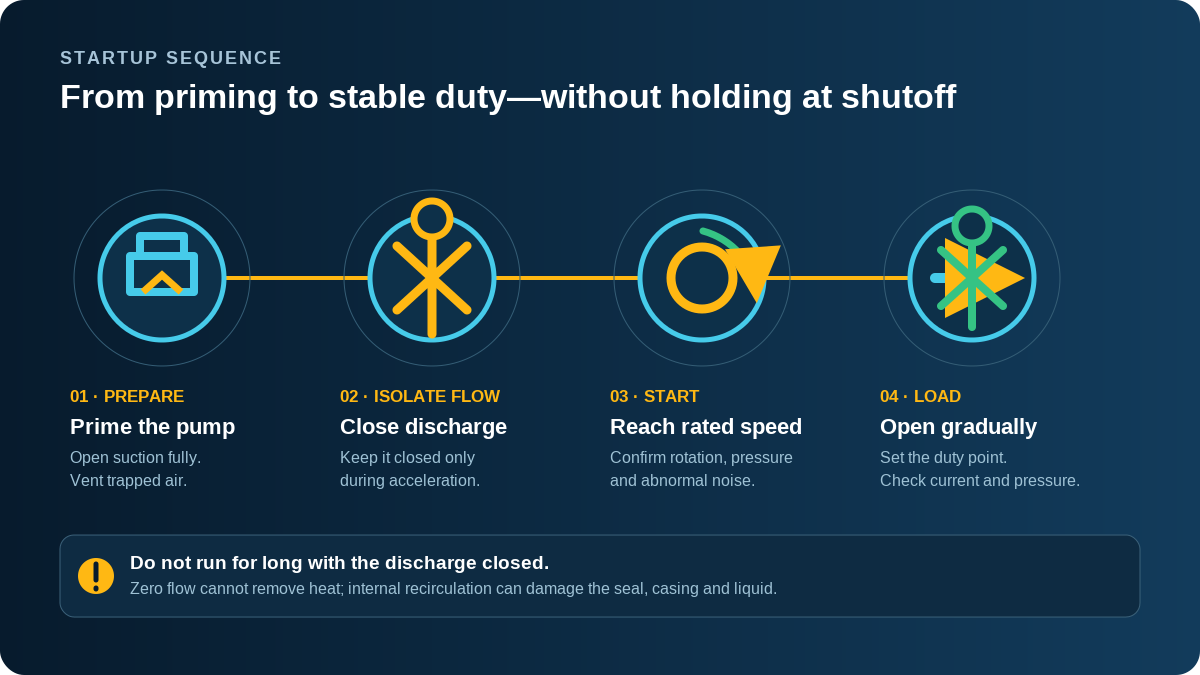
- 01
Prime and vent
Confirm the casing and suction line are full of liquid. Open the suction valve fully and release trapped air. Check lubrication or cooling arrangements where the selected pump requires them.
- 02
Set the discharge valve
Close the discharge valve or set it to the manufacturer’s recommended minimum-opening position. Make sure any minimum-flow bypass specified for the installation is available.
- 03
Start and verify
Energise the motor. Confirm rotation direction, acceleration, shutoff pressure, vibration and sound. Stop immediately if the pump fails to build pressure or shows dry-running symptoms.
- 04
Open gradually to duty
Open the discharge valve slowly while watching discharge pressure, suction pressure and motor current. Stop at the required operating point and verify that current remains below the motor nameplate limit.
04 / OPEN-VALVE START
What can happen if the outlet is fully open
| Possible effect | Why it happens | What the operator may observe |
|---|---|---|
| Higher hydraulic acceleration load | Flow begins while the rotor is still accelerating, increasing required torque as speed develops. | Longer acceleration, a deeper voltage dip or protection trip in a marginal electrical system. |
| Sudden pipe filling or flow change | The liquid column accelerates rapidly instead of being introduced gradually. | Pipe movement, pressure fluctuation, noise or water hammer. |
| Operation too far to the right | A low-resistance system can pull the pump toward high flow before the duty valve is set. | High motor current, low developed head, vibration or poor efficiency. |
| Uncontrolled parallel-pump interaction | A newly started pump immediately interacts with the common header and running pumps. | Check-valve movement, flow redistribution or unstable pressure. |
An open discharge valve does not guarantee failure. Some small systems start this way without visible damage, and some automatic installations are designed for it. The point is control: the operating procedure should be based on the pump curve, motor start, check-valve behaviour and pipeline response—not habit alone.
05 / EXCEPTIONS AND RISKS
Do not apply the rule to every pump type
Axial-flow pumps
The absorbed-power curve may be highest at low flow or shutoff. Starting against a closed valve can overload the motor. Follow the manufacturer’s curve and procedure.
Mixed-flow pumps
Power behaviour depends on the hydraulic design. Do not assume it matches a radial-flow inline pump.
Positive-displacement pumps
Never start against a closed discharge unless an effective relief path is provided. Pressure can rise rapidly and damage the pump, pipework or people nearby.
Minimum-flow systems
Large or hot-liquid centrifugal pumps may require a bypass or minimum continuous stable flow. The project procedure takes priority over a generic closed-valve start.
Why prolonged shutoff operation is dangerous
With no external flow, the liquid cannot carry heat away. Internal recirculation around the impeller eye and volute becomes stronger, temperature rises, and local pressure may fall enough for vapour formation. Extended shutoff can damage the mechanical seal, distort components, increase vibration and—in hot or volatile services—create a serious pressure hazard.
Reach stable speed, verify pressure and begin opening the valve without unnecessary delay. Respect the pump manufacturer’s maximum shutoff time and minimum continuous flow.
06 / OPERATOR CHECKLIST
What to verify before and after every start
- Before starting: pump and suction line full of liquid; suction valve fully open; discharge valve in the specified start position.
- Electrical: correct voltage, phase, protection setting and permitted starting method.
- Mechanical: free rotation where applicable, coupling guard fitted, lubrication ready and no visible leakage.
- Immediately after starting: correct rotation direction, normal sound, stable pressure and no abnormal vibration.
- While opening: increase flow gradually while monitoring discharge pressure, suction pressure and motor current.
- At duty: confirm the operating point is within the selected pump range and not below the required minimum flow.
- If pressure does not build: stop the pump; do not keep it running dry while searching for the cause.
07 / QUESTIONS
Common inline pump startup questions
Why does a closed outlet reduce load if pressure is highest at shutoff?
Pressure or head is only one part of hydraulic power. Hydraulic output is proportional to flow multiplied by head. At shutoff, head is high but external flow is nearly zero, so useful hydraulic output is low. The motor still supplies internal-loss power, which is why the selected model’s absorbed-power curve remains important.
Should the suction valve also be closed before starting?
No. A centrifugal inline pump needs a flooded, vented suction path. Closing or throttling the suction valve reduces inlet pressure and can cause dry running, cavitation and seal damage.
How fast should the discharge valve be opened?
Slowly enough to avoid a sudden flow and pressure change, but not so slowly that the pump remains at shutoff or below minimum flow for too long. Use the manufacturer’s procedure and watch pressure and current while opening.
Does a VFD mean the discharge valve can remain open?
Not automatically. A VFD gives better acceleration control, but the starting sequence still depends on system resistance, check valves, minimum flow, parallel pumps and the programmed speed ramp. Commission the valve and speed logic as one system.