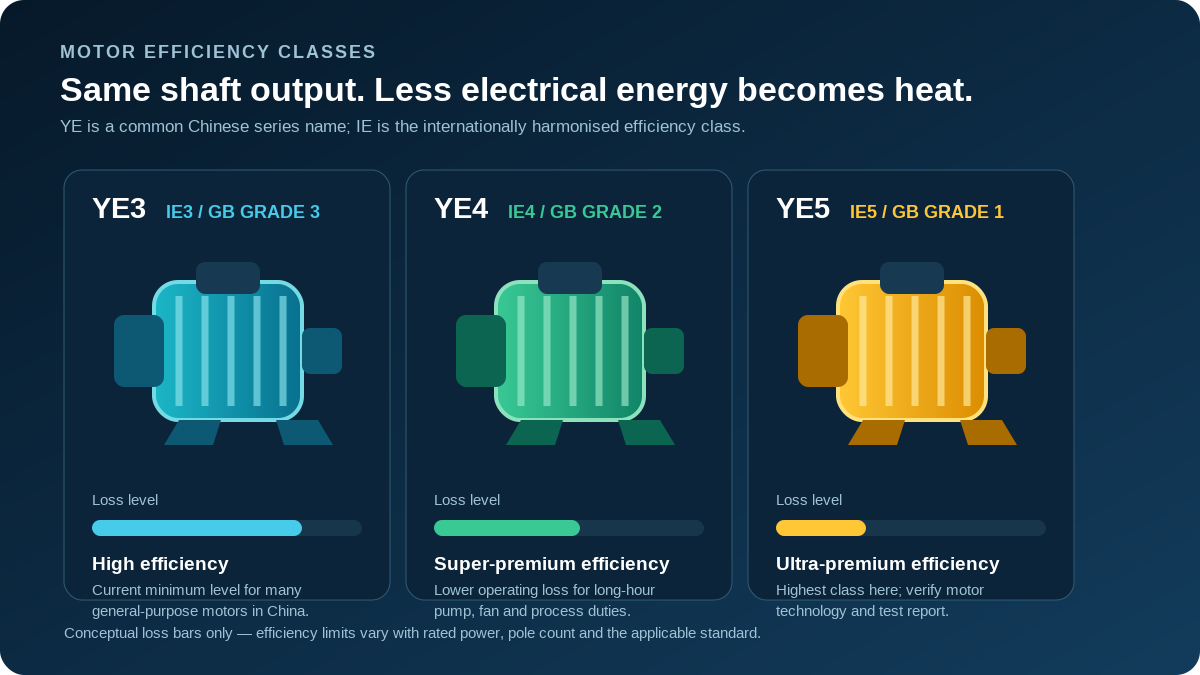
A higher YE number normally means a higher target efficiency—not more motor output. For the same required pump shaft power, YE4 loses less energy than YE3, and YE5 loses less than YE4. Judge the class by standardized efficiency testing and the correct limit table for rated power, poles and frequency. Do not accept the model name alone as proof, and do not confuse motor efficiency with the efficiency of the complete pump system.
01 / TERMINOLOGY
YE, IE and “ordinary induction motor” are not the same kind of label
Induction motor describes the operating principle: the stator’s rotating magnetic field induces current in the rotor, and rotor slip produces torque. A conventional three-phase squirrel-cage motor can be built to several efficiency levels.
YE3, YE4 and YE5 are common Chinese product-series designations. IE3, IE4 and IE5 are internationally harmonised efficiency classes. For covered three-phase asynchronous motors under China’s current GB 18613—2020, Grade 3, Grade 2 and Grade 1 generally align with IE3, IE4 and IE5 respectively.
The phrase may refer to an older Y, Y2 or YE2 design, or simply to a standard squirrel-cage induction motor. Read the actual rated efficiency, efficiency grade, standard, power, pole count and test report instead of comparing a vague “ordinary” label with YE3, YE4 or YE5.
As checked on 13 November 2026, GB 18613—2020 remains the current Chinese national standard. A revision project is underway, so specifications for future projects should always state the required standard edition.
02 / COMPARISON
What actually changes from YE3 to YE4 and YE5
| Item | YE3 | YE4 | YE5 |
|---|---|---|---|
| Common class association | IE3 / China Grade 3 | IE4 / China Grade 2 | IE5 / China Grade 1 |
| Main objective | High efficiency and regulatory compliance | Lower lifecycle energy loss | Ultra-premium efficiency |
| Typical design effort | Improved copper, core and fan design | Further reduction of copper, iron, mechanical and stray losses | Aggressive loss reduction; technology and frame may differ |
| Purchase cost | Usually lowest of the three | Usually higher | Usually highest |
| Best economic fit | General-purpose compliant duty | Long daily operating hours and high energy cost | Very long runtime, high energy cost or strict efficiency target |
| What it does not guarantee | Starting current, starting torque, power factor, noise, VFD suitability, bearing life or complete pump efficiency must be checked separately. | ||
A numerical example from GB 18613—2020
For a 4 kW, 4-pole motor at 50 Hz, the example full-load efficiency thresholds are 88.6% for Grade 3, 91.1% for Grade 2 and 92.8% for Grade 1. These values cannot be copied to another power or pole count; every rating has its own limit.
At the example thresholds, the approximate electrical inputs are 4.51 kW, 4.39 kW and 4.31 kW respectively. The saving is continuous whenever the motor delivers the same shaft output, but real part-load performance and system control still matter.
03 / LOSS REDUCTION
Where the efficiency improvement comes from
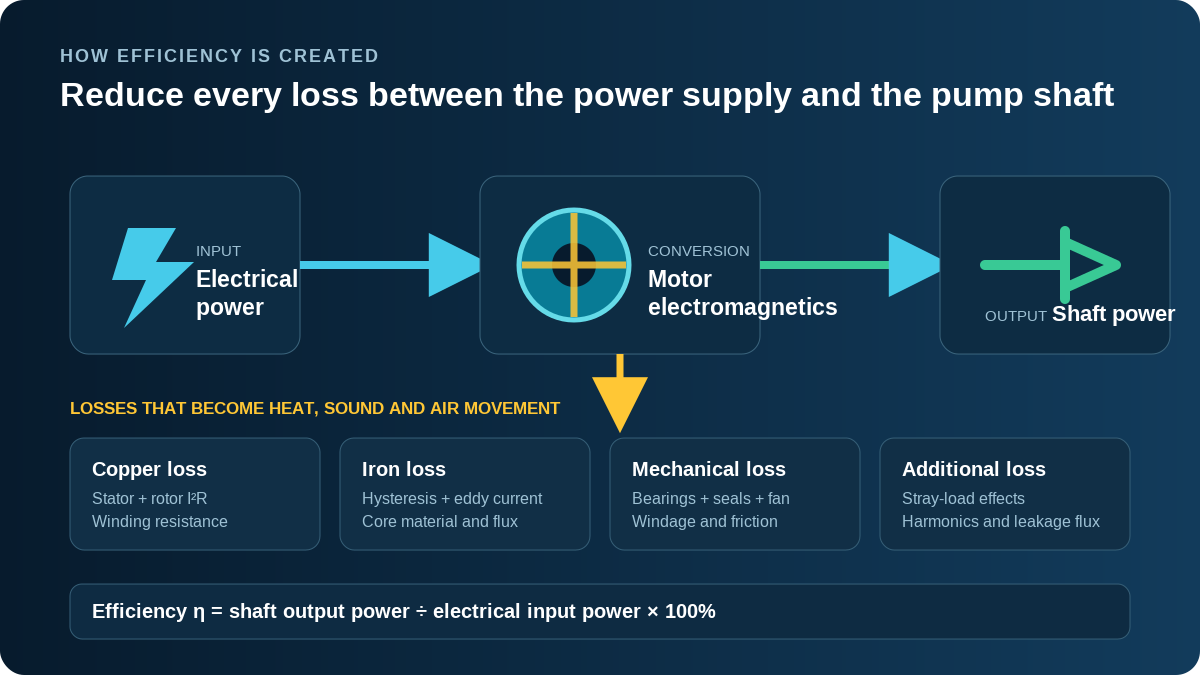
- Lower copper loss: more conductor area, improved slot fill, shorter end turns and lower-resistance rotor design reduce I²R heating.
- Lower iron loss: better electrical steel, thinner laminations, controlled flux density and improved punching and assembly reduce hysteresis and eddy-current loss.
- Lower mechanical loss: efficient fan design, appropriate bearings, seal selection and air-gap control reduce friction and windage.
- Lower stray-load loss: slot geometry, rotor bars, winding distribution and manufacturing consistency reduce additional electromagnetic loss.
- Thermal design: lower loss normally means less heat, but frame temperature still depends on cooling, ambient, load, voltage balance and installation.
More active material or a different electromagnetic design may increase frame length, weight or rotor inertia. Check mounting dimensions, shaft, coupling, starting method and replacement compatibility before changing an installed pump motor.
04 / ASSESSMENT
How YE3, YE4 and YE5 are actually judged
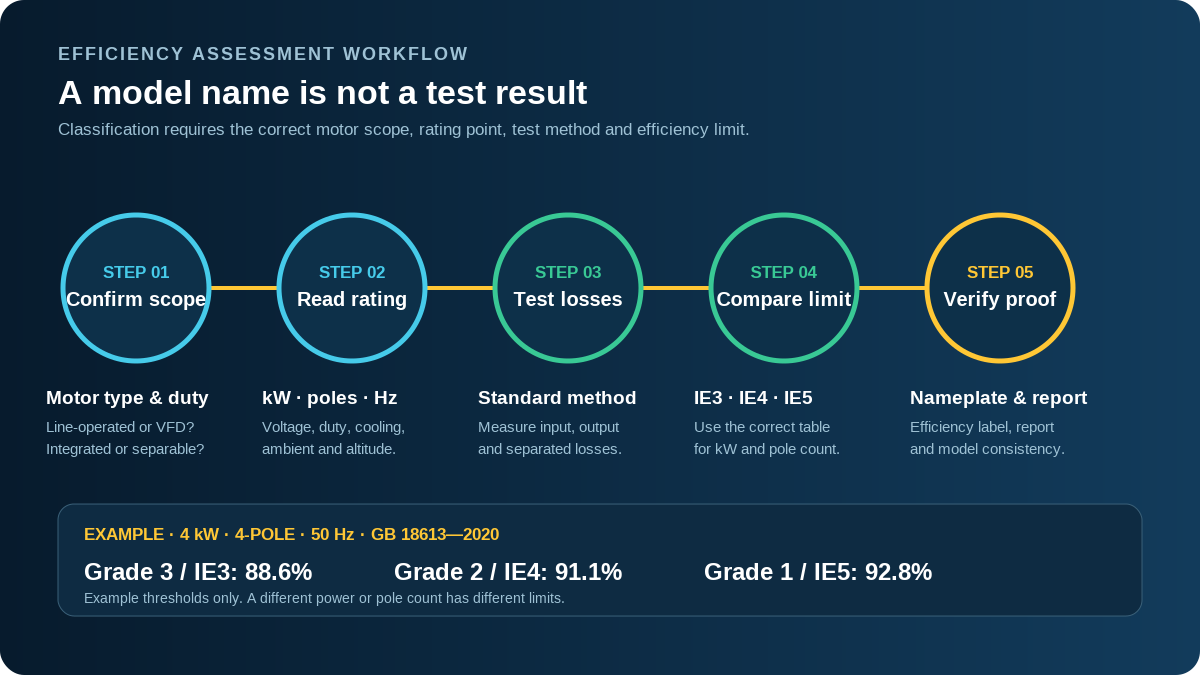
- 01
Confirm the motor is inside the standard’s scope
Check motor principle, supply, power, pole count, duty, cooling, ambient, altitude and whether the motor can be tested separately. Fully integrated and submersible motors can fall outside the same classification scope.
- 02
Define the exact rating
Use rated output power—not input power—plus pole count, frequency and rated operating condition. A 4 kW 2-pole motor and a 4 kW 4-pole motor do not share the same limit.
- 03
Measure input, output and losses
For China, the current test-method reference is GB/T 1032—2023 for three-phase asynchronous motors. International testing uses methods such as IEC 60034-2-1:2024.
- 04
Compare rated efficiency with the correct table
The measured and declared efficiency, including the permitted tolerance and rating rules, must satisfy the applicable threshold for that exact motor rating.
- 05
Keep the evidence consistent
Model, frame, winding, voltage, frequency, duty, rated efficiency and test sample in the report must match the offered motor. A report for a similar model is not enough.
The current international class document is IEC 60034-30-1:2025. Its second edition introduced IE5 nominal efficiency limits for covered line-operated AC motors.
05 / VERIFICATION
How a buyer should verify the efficiency claim
Nameplate
Check rated output kW, voltage, frequency, current, speed, efficiency, power factor, duty, insulation, enclosure and stated IE or energy grade.
Energy label
Where China’s energy-label rules apply, confirm the grade, model and efficiency value are consistent with the offered motor.
Test report
Ask for the standard edition, test method, rated efficiency, loss breakdown and exact sample model. Verify the laboratory and report validity where required.
Complete datasheet
Compare starting current, torque, power factor, temperature rise, noise, bearings, VFD range and mechanical dimensions—not efficiency alone.
Efficiency changes with power and pole count. A credible catalogue provides rating-specific values or a traceable table. Also verify whether the value is nominal, guaranteed minimum or measured sample efficiency.
06 / PUMP SELECTION
Choosing the right motor for a water pump
Start with the pump duty point, not the efficiency label. Select the pump near its efficient operating region, calculate the maximum absorbed shaft power across the permitted operating range, then choose a motor with suitable service margin and starting characteristics.
| Operating situation | Practical starting point | Main checks |
|---|---|---|
| Occasional small pump | YE3 may provide the best total cost | Annual hours, purchase price, compliance and starting frequency |
| Continuous circulation or industrial transfer | Compare YE4 and YE5 lifecycle cost | Load profile, tariff, annual hours, spare compatibility and payback |
| Variable-flow booster system | High-efficiency motor plus correctly selected VFD | Converter suitability, cooling at low speed, harmonics and control range |
| Direct replacement | Do not select by kW and efficiency alone | Frame, shaft, flange, speed, current, torque, inertia and protection |
| Submersible pump | Use the pump-set and motor-specific standard/data | Immersed motor scope, cable loss, cooling, sealing and complete wire-to-water efficiency |
Motor efficiency is not pump-system efficiency
A YE5 motor cannot correct an oversized pump, a duty point far from best efficiency, excessive throttling or a high-friction pipe. Evaluate wire-to-water efficiency: motor, drive, pump hydraulics and the complete system. In many installations, correcting pump selection or control saves more energy than changing only the motor class.
Use the real load profile—not only rated kW. Add electricity tariff, purchase cost, maintenance, VFD losses and expected service life before deciding between YE3, YE4 and YE5.
07 / QUESTIONS
Common YE3, YE4 and YE5 questions
Is YE5 always a permanent-magnet motor?
No. IE efficiency classes are technology-neutral. A manufacturer may reach a high class with an induction, permanent-magnet or synchronous-reluctance design depending on the product and applicable standard. Confirm the motor principle and control requirement.
Does YE5 always run cooler than YE3?
Lower losses generally reduce heat at the same shaft output, but observed temperature also depends on cooling, frame size, ambient temperature, voltage balance, switching harmonics, load and mounting. Compare temperature-rise data under the same test condition.
Can I identify the class from current alone?
No. Current also depends on voltage, power factor, load and design. Efficiency classification requires standardized input-output or loss testing and comparison with the correct limit.
Will a YE5 motor always save money?
Not always. Savings are strongest with high annual runtime and substantial load. For an occasional pump, the additional purchase and replacement cost may exceed the energy saving. Calculate lifecycle cost from the actual duty.
OFFICIAL REFERENCES
Standards used for this guide
- GB 18613—2020 — Minimum allowable values of energy efficiency and values of efficiency grades for motors
- GB/T 1032—2023 — Test methods for three-phase asynchronous motors
- IEC 60034-30-1:2025 — Efficiency classes of line-operated AC motors
- IEC 60034-2-1:2024 — Standard methods for determining losses and efficiency from tests