Use a closed impeller when clean liquid, hydraulic efficiency and stable performance are the priorities. Consider an open, semi-open, vortex or non-clog design when fibres, gas, solids, deposits or frequent cleaning are expected. Then select the material from corrosion, abrasion, temperature, speed and strength—not from price or the word “stainless” alone.
01 / STRUCTURE
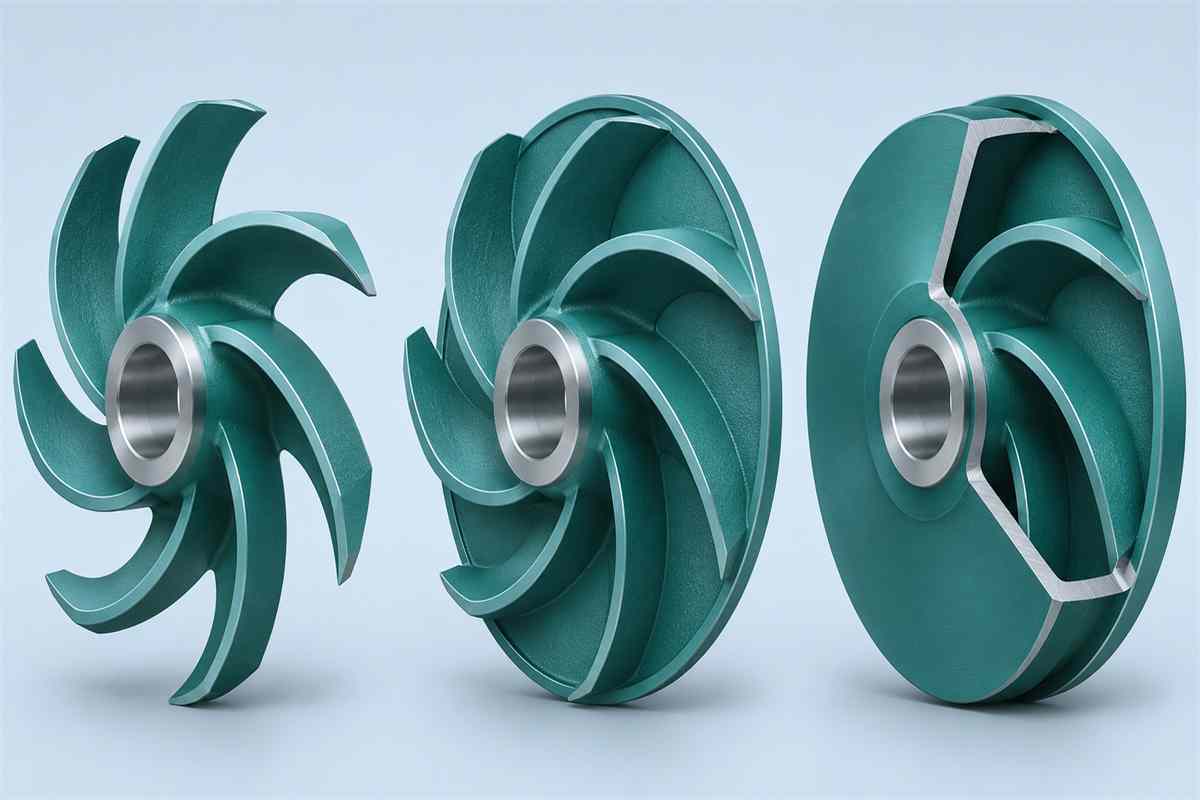
Open, semi-open and closed are descriptions of shrouding
The impeller vanes add energy to the liquid. A shroud is the disc-like surface beside those vanes. Adding a front shroud encloses the flow channels; removing it exposes the vane edges to the casing or wear plate.
Open impeller
Vanes are exposed on the suction side and, in some designs, on both sides. The wide and visible passages are easier to inspect and clean. Performance is strongly affected by the running clearance to the casing or wear plate.
Semi-open impeller
A back shroud supports the vanes while the front remains open. It is a common compromise for liquids containing some suspended solids or crystals while retaining better hydraulic guidance than a fully unshrouded rotor.
Closed impeller
Front and back shrouds enclose the vane passages. This normally supports higher efficiency and controlled internal leakage in clean-liquid duties, but the passages can retain stringy solids or deposits if the hydraulic design is unsuitable.
Some manufacturers call an impeller with a back shroud but no front shroud “open”; others call the same arrangement “semi-open”. Purchase from the drawing, free-passage dimension and vane/channel description—not from the label alone.
02 / OPEN VS CLOSED
The practical trade-offs
| Selection factor | Open / semi-open | Closed |
|---|---|---|
| Peak hydraulic efficiency | Usually lower because the open side permits more recirculation and disc-clearance losses. | Usually higher for clean-liquid designs because the channels guide the liquid and leakage is controlled at wear rings or close clearances. |
| Solids and fibres | Exposed passages can be easier to clear and inspect; open, vortex and cutter geometries are available. | Multi-vane clean-water types can clog, but a closed single-channel or large-passage impeller may handle coarse solids very well. |
| Clearance wear | Head and efficiency can fall quickly as the clearance to the wear plate grows. Some pumps provide an external adjustment. | Wear is managed through front/back wear rings or controlled clearances; internal inspection may require more disassembly. |
| Cleaning and deposits | Vanes are accessible, useful where crystals, food residue or sticky deposits must be removed. | Enclosed channels are harder to inspect and can retain deposits, although clean service often needs little attention. |
| Mechanical stiffness | Unshrouded vane tips receive less structural support and may limit diameter, speed or severe-duty use. | Two shrouds provide a stiff wheel suitable for many higher-speed and higher-energy services. |
| Manufacturing and balance | Simple access allows machining and cleaning, but tip clearance and wear-plate flatness are critical. | More complex casting and internal finishing; good balance and passage uniformity remain essential. |
Vane count, free passage, impeller diameter, rotational speed, specific speed, vortex or channel geometry, cutter arrangement and casing shape can be more important than whether a front shroud is present.
03 / OPERATING CONDITIONS
Which structure suits which duty?
| Operating condition | Useful starting point | What must be verified |
|---|---|---|
| Clean cold water, building supply, irrigation | Closed radial impeller for efficiency and stable head. | NPSH, duty point, sand content, motor load and operation near the preferred range. |
| HVAC and hot-water circulation | Closed impeller; metal or temperature-rated engineering polymer. | Water treatment, oxygen content, maximum temperature, pressure rating and thermal expansion. |
| Raw sewage with wipes or fibres | Open, vortex, cutter or verified non-clog channel impeller. | Free passage, ragging tendency, gas content, sand, dry solids and actual wastewater composition. |
| Storm water or screened wastewater | Semi-open or closed channel impeller, depending on solids size and efficiency target. | Maximum particle size, free passage and intermittent versus continuous duty. |
| Sand, mineral slurry and abrasive particles | Wide-passage open/semi-open or purpose-built slurry impeller. | Particle hardness, size and shape, solids concentration, impact, velocity and corrosion. |
| Food, beverage and sanitary liquids | Polished stainless open or closed sanitary design according to solids and cleaning method. | Surface finish, drainability, CIP/SIP temperature, shear sensitivity and food-contact certification. |
| Chemicals, acids and alkalis | Open or closed chemical-pump geometry in compatible metal or fluoropolymer. | Exact concentration, temperature, contaminants, pressure, permeation and seal compatibility. |
| Viscous liquid | Open/semi-open can reduce passage restriction, but a positive-displacement pump may be better. | Viscosity at operating temperature, required flow, efficiency correction and shear sensitivity. |
| Liquid containing entrained gas | Open, vortex or gas-handling hydraulic design. | Gas volume fraction, suction conditions, priming and whether a side-channel or self-priming pump is required. |
04 / MATERIAL FAMILIES
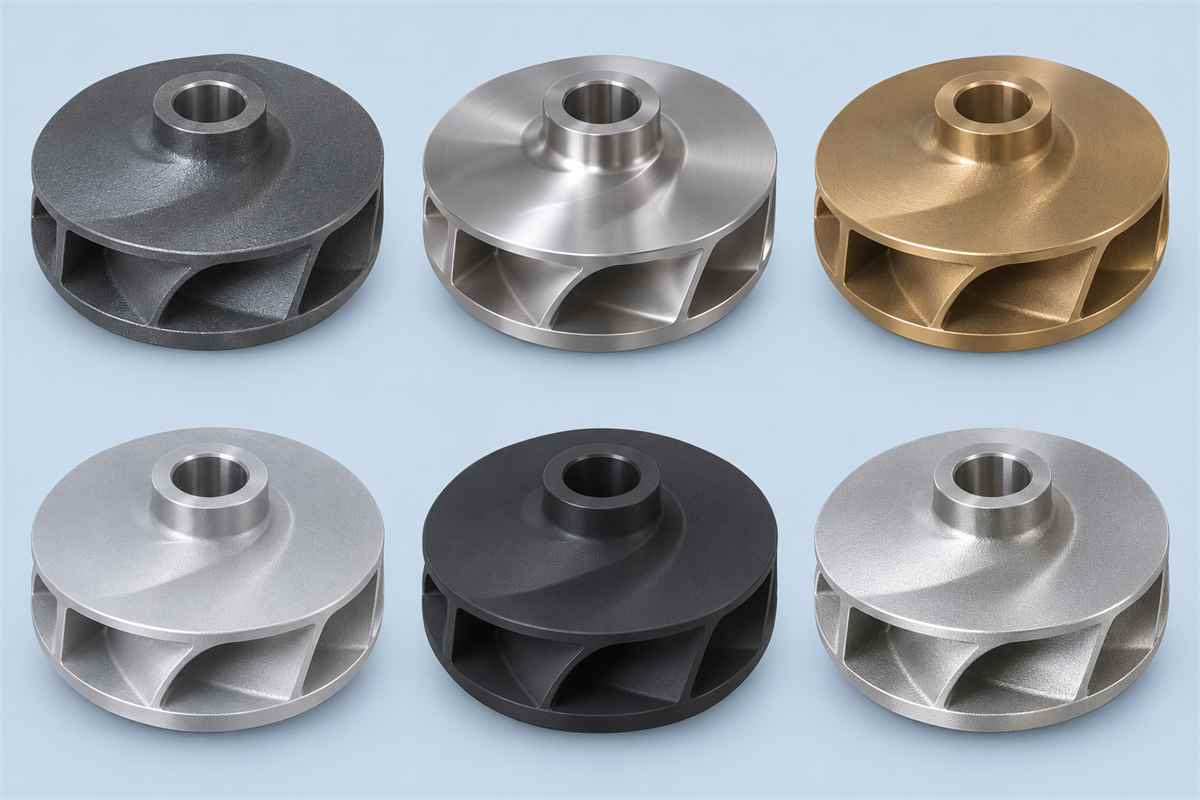
Impeller material changes corrosion, wear, temperature and mechanical limits
Grey cast iron
Economical, castable and mechanically suitable for many clean-water and municipal wastewater duties. It is not a universal choice for low-pH liquids, high chloride or severe abrasion.
Ductile iron
Higher toughness and impact strength than grey iron. Used in larger or more highly loaded impellers, but corrosion and erosion still require application review.
Cast or carbon steel
Used where strength, pressure or weldability is important. It usually needs corrosion allowance, coating or controlled water chemistry.
304, 316 and 316L stainless
Good cleanliness and corrosion resistance for many waters and process liquids. 316/316L improves resistance over 304 in many environments, but neither is automatically safe for warm chlorides or abrasive slurry.
Duplex and super-duplex stainless
Combines high strength with improved chloride and pitting resistance. Common in seawater, corrosive wastewater and demanding process service when the selected grade matches the chemistry.
Bronze and gunmetal
Traditional water-pump materials with useful corrosion, casting and anti-galling properties. Verify lead restrictions, water chemistry and compatibility with the casing and shaft.
Aluminum bronze and nickel-aluminum bronze
Stronger than many tin bronzes and widely considered for seawater and marine pumps. Flow velocity, sulfides, galvanic pairing and procurement specification remain important.
Aluminum alloy
Low mass helps small portable and domestic pumps. It is best for compatible clean liquids and controlled temperatures; erosion, cavitation, pitting and galvanic corrosion can shorten life.
High-chrome white iron
Very hard and widely used for abrasive wastewater and slurry components. Its wear advantage can be lost where large impact loads, cracking risk or incompatible corrosion dominate.
Rubber or polyurethane-covered metal
Elastomeric wear surfaces can perform well with fine particles and lower cutting impact. Temperature, chemical compatibility, particle sharpness and speed limit their use.
PP and glass-filled PP
Polypropylene offers low weight and broad resistance to many acids and alkalis. Glass reinforcement improves stiffness, but temperature, creep, impact and chemical concentration must stay inside the compound rating.
PPO / modified PPE
PPO-based engineering blends are not the same as PP. Their dimensional stability and low water absorption suit some pool, domestic and circulation-pump impellers; the exact blend and glass content determine limits.
PPS, PES and glass-filled PA
Engineering polymers used in selected circulators and compact pumps. PPS offers useful heat and chemical resistance; nylon grades require careful review of water absorption, hydrolysis and temperature.
PVDF, ETFE, PFA and PTFE systems
Fluoropolymers cover many aggressive chemical duties. Strength, moulding method, permeation, temperature and pressure differ substantially; use the exact manufacturer resistance chart.
Titanium
Chosen for selected chloride, seawater and oxidising environments where its passive film is stable. High cost, galling, crevice conditions and incompatible reducing acids require specialist review.
Nickel alloys, Hastelloy and Monel
Reserved for severe chemical or high-temperature services where standard stainless grades are inadequate. The correct alloy depends on oxidising or reducing chemistry, chlorides and contaminants.
Ceramics and hard coatings
Silicon carbide, ceramics and tungsten-carbide-type coatings can protect high-wear zones. Brittleness, bonding, repair method and differential expansion must be engineered.
“PP0” is not a sufficiently precise purchasing specification. If the intended material is PP, state polypropylene and the reinforcement grade. If the intended material is PPO, confirm whether the manufacturer means a modified PPE/PPO engineering blend and obtain its temperature, strength and chemical-resistance limits.
05 / MATERIAL BY LIQUID
A useful starting matrix—not a substitute for the chemical chart
| Liquid or environment | Common starting materials | Important cautions |
|---|---|---|
| Clean fresh water | Cast iron, bronze, stainless, aluminum or rated engineering polymer. | Temperature, oxygen, disinfection chemicals, sand and potable-water approval. |
| Municipal wastewater | Grey/ductile iron, high-chrome iron or duplex for more corrosive service. | Sand makes wear important; stainless is not automatically more wear-resistant. Check galvanic effects on the whole pump. |
| Seawater and chloride water | Nickel-aluminum bronze, duplex/super-duplex or titanium in severe compatible service. | Temperature, flow velocity, sulfides, oxygen, crevices and galvanic couples can change the answer. |
| Abrasive mineral slurry | High-chrome white iron, selected elastomer or polyurethane systems, specialist hard coatings. | Large hard particles create impact; fine slurry creates erosion. Corrosion and abrasion can accelerate each other. |
| Dilute acids and alkalis | PP, PVDF, ETFE or suitable stainless/special alloy after compatibility review. | Concentration and temperature are inseparable; contamination can reverse a material recommendation. |
| Solvents | PVDF, ETFE, PFA, PTFE-lined or compatible metal depending on the solvent. | PP, seals and adhesives may swell or crack. Confirm permeation and hazardous-area requirements. |
| Hot water and condensate | Cast iron, bronze, stainless, PPS or another temperature-rated construction. | Cavitation margin, thermal shock, oxygen and polymer creep become critical. |
| Food and pharmaceutical liquids | Polished 316L or certified engineering polymer. | Cleanability, surface finish, certification, sterilisation temperature and product contamination control. |
Material names are only families. “Stainless steel”, “bronze” and “plastic” are not complete specifications. Record the exact grade, heat treatment, reinforcement, hardness and applicable standard on the quotation and drawing.
06 / WRONG-SELECTION EFFECTS
What happens when the structure or material is wrong?
Low efficiency
An unnecessarily open impeller or excessive wear-plate clearance can increase recirculation, reduce head and raise the energy cost per cubic metre.
Clogging and ragging
A narrow multi-vane closed impeller may trap fibres, wipes or crystals, reducing flow and causing repeated overload trips.
Erosion and loss of balance
A soft or corrosion-weakened material can lose metal unevenly. Vibration then loads bearings, seals and the shaft.
Pitting or perforation
The wrong alloy or polymer can pit, swell, crack or lose strength. Leakage products may also contaminate the pumped liquid.
Damage moves elsewhere
A noble stainless impeller fitted into a less noble cast-iron assembly may accelerate corrosion of adjacent wetted parts if the electrochemical system is not controlled.
Deformation or cracking
Polymers can creep at temperature and high peripheral speed; hard brittle alloys can crack under impact or thermal shock.
Surface pitting
Even a corrosion-resistant material can suffer cavitation erosion when inlet pressure is inadequate. Material upgrades do not repair an NPSH problem.
Mechanical failure
Incorrect strength, casting quality, speed rating or balance can cause vane or shroud failure with serious equipment risk.
07 / SELECTION WORKFLOW
Nine checks before approving the impeller
- 01
Fix the duty point
State flow, total dynamic head, speed, frequency, operating hours and the expected range—not only the maximum values.
- 02
Describe the liquid precisely
Record temperature range, density, viscosity, pH, chlorides, chemical name and concentration, gas content and contamination.
- 03
Quantify solids
Give maximum particle size, concentration, hardness, shape, fibres, wipes and whether the solids settle or form crystals.
- 04
Select the hydraulic geometry
Compare open, semi-open, vortex, cutter, single-channel and closed multi-vane options using free passage and efficiency at the real duty point.
- 05
Check corrosion and abrasion together
Corrosion can remove the protective surface while abrasion removes passive films. Use operating temperature in the resistance review.
- 06
Verify mechanical limits
Confirm material strength, maximum diameter, rotational speed, balance grade, temperature and possible impact.
- 07
Check the whole wetted assembly
Impeller, casing, wear rings, shaft, fasteners and seal must be compatible. Avoid creating an uncontrolled galvanic couple.
- 08
Confirm NPSH and suction conditions
Cavitation damage cannot be solved by impeller material alone. Compare NPSHA with NPSHR and keep the inlet flow uniform.
- 09
Freeze the specification
Put the exact impeller type, drawing, material grade, hardness or reinforcement, direction of rotation and performance curve on the order.
08 / QUESTIONS
Common questions about impeller selection
Is a closed impeller always more efficient?
It usually offers higher peak efficiency in comparable clean-liquid radial designs, but a worn closed impeller or one operating far from its best efficiency point may perform worse than a correctly selected open or channel impeller. Compare certified curves at the actual duty.
Can a closed impeller pump solids?
Yes. Closed single-vane and channel impellers can provide a large non-clogging passage. Solids capability depends on channel shape, vane count and free-passage size, not only on the shroud.
Is 316 stainless suitable for seawater?
It may be used only in carefully controlled conditions, but warm, stagnant or high-chloride seawater can cause pitting and crevice corrosion. Nickel-aluminum bronze, duplex, super-duplex or titanium may be considered after a full chemistry and galvanic review.
Should I choose PP or PPO for a domestic pump?
Do not interchange them by name. Confirm the exact compound, glass content, temperature, speed, pressure and liquid compatibility specified by the pump manufacturer. PPO-based blends typically emphasise dimensional stability; PP typically emphasises chemical resistance and cost.
Can I replace a cast-iron impeller with stainless steel?
Only after checking hydraulic dimensions, balance, shaft loading, corrosion of adjacent materials and abrasive wear. The replacement must match the performance curve and the complete pump material system.